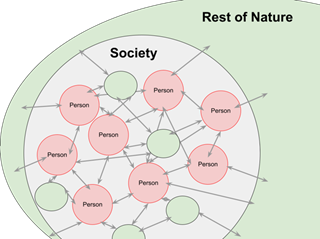
An understanding of Social Ecology focuses the idea that Rights of Nature must be rooted in changing social relations.
Note: this blog post was started by Alex May in early 2026. Due to severe illness Alex was unable to complete this alone. The unfinished blog was posted, with a description of the draft status at the top. The thinking being that it is better to have a basic version available than nothing at all. To expand upon the ideas in the text, and bridge the gaps in the draft using writing Alex completed elsewhere, a research assistant provided support to finish the blog. The text below is the completed version.
Introduction
Political discourse and social movements typically make strong moral arguments and seek to have rights enshrined in law – and this is the case with Rights of Nature. Yet changing the law is not itself the goal; rather, just one part of social change. In our campaigning and legal designs, we must look beyond the legal change and keep our eyes on the goal of: how will Rights of Nature change the underlying social relations.
The key question is: how does this law help change social relations to address the problems and move us towards a more just world. In approaching this, an understanding of Social Ecology is vital. How can Rights of Nature laws change eco-social relations – which drive the destruction – so that non-human nature is protected and can flourish?
What Is Social Ecology?
Starting with how we conceptualise both ‘the environment’ and society helps to clarify things. Social Ecology is an excellent foundation for this. The core point is that society is part of nature, not separate from it, and our ecological relationships and our social relationships cannot be separated. Humans are part of nature. This seems obvious but actually most of “green” politics is still based on ‘nature’ as some ‘other’ and most critical scholarship has been either social or ecological. Critical scholarship has been partial, either society abstracted from nature or ecological relations abstracted from social relations.
Social Ecology was formulated by Murray Bookchin in the late 1960s. the concept inverts anthropocentrism, viewing society as within nature. Bookchin’s core argument is that ecological destruction is part of social domination between humans and (almost) all “environmental” issues are rooted in social relations. Given that ecological and social relationships are interconnected, addressing ecological destruction must also address social domination, and vice versa. Ecological destruction is enmeshed in many aspects of society, relations and human activity.
Society is the segment of nature involving human activity. All social relations are ecological and some ecological relations are social. All social relations are ecological because humans and society are within an ecological world. Not all ecological relations are social relations because there are nonhuman ecological relations: birds eating fish, fungi and trees relating, ants and aphids, and uncountable others. Yet all ecological relations which involve humans are social relations: when humans are involved, social and ecological are inseparable. And, of course, there are various relations in which human activity impacts nonhuman ecology: these are not separate worlds, just that these exist outside of “society” (though, never fully outside it, everything is still interconnected and entangled).
“Environmental” problems are actually about social relations. The domination of nature is rooted in social domination. To achieve ecological harmony, we must change society. “Green” politics must be social politics because, in short, the ecological crisis is a social crisis. In Murray Bookchin’s words:
“What literally defines social ecology as “social” is its recognition of the often overlooked fact that nearly all our present ecological problems arise from deep-seated social problems. Conversely, present ecological problems cannot be clearly understood, much less resolved, without resolutely dealing with problems within society. To make this point more concrete: economic, ethnic, cultural, and gender conflicts, among many others, lie at the core of the most serious ecological dislocations we face today – apart, to be sure, from those that are produced by natural catastrophes.” 1
In other words, ecological destruction is part of social domination between humans. Which means that attempts to address our ecological relationships must also consider social relationships. Ultimately, we cannot only think about “Nature”. We must think about the human social systems which cause ecological harm and also are part of social oppression. Environmental politics does not make sense, and cannot be seriously effective in transforming the relationships between humans and the rest of Nature, if it is not also involving social political issues.
Delineating Narrow and Broad Social Ecology
One of the initial confusions is that the phrase ‘social ecology’ can have a range of meanings. I will therefore delineate these between ‘narrow’ and ‘broad’ Social Ecology. As a term, it contains a range of scopes of meaning, from the (literal) understanding of society and ecology through to the full political project which Bookchin roots in this. To be clear, this is a distinction which I am creating, using ‘narrow social ecology’ as shorthand for the philosophy of nature and conceptual framework of Bookchin’s which I am using, and am not saying this is a normal way of using the term.
To show that this variety of uses exists see Bookchin’s use: “Social ecology is an appeal not only for moral regeneration but, and above all, for social reconstruction along ecological lines.” 2 and a one-line summary by a commentator: “The basic promise of social ecology is to re-harmonize the relationship between society and nature, and to create a rational, ecological society.” 3 This usage is one of many examples of the broad use of the term. The re-harmonisation described is both philosophical and social, a conceptual foundation and a political project.
The distinction which I wish to make is that ‘narrow’ social ecology is the conceptual framework for understanding the relationship between society and ecology, humans and nature, whereas the ‘broad’ social ecology includes Bookchin’s political project of what to do about this. Bookchin uses terms for his political project which are not social ecology: initially he talks of ‘post-scarcity anarchism’ (1971 book title), then of ‘libertarian municipalism’ (eg in his 1990 book Remaking Society), then, later, of ‘communalism’ (as he also notably dropped the term anarchist due to both its baggage and the difference between his thinking and differences with the dominant strain of anarchism).
Can this separation be made? I’m not entirely sure. I think it is possible to take the conceptual foundations of a project without taking the spires that the thinker builds on those foundations. Ultimately, though, this question becomes less about whether the conceptual foundations of Bookchin’s work can be taken and used while leaving his political project behind, and more about whether any neutral’ positivist project or a theory of law which is not wedded to a political theory. To put things otherwise: my legal theory project here is not necessarily to take a social ecology project to law, but rather to develop a socio-ecologicaly holistic approach to legal theory. My project is distinct from that of Bookchin’s. It needs a conceptual foundation, a theory of nature and society, and Bookchin’s is the foundation I use from which to think about law.
In summary, it is the philosophical strand of Social Ecology (narrow), in which relations are the focus, that is applicable to the approach to Rights of Nature which I am proposing. Bookchin’s proposals of what to do about that – Bookchin’s communitarian political project (broad) – is not so applicable to Rights of Nature but worth understanding in order to contextualise my thoughts below.
Law and Eco-Social Relations
We have to ask what social relations are causing ecological destruction, what sustainable and harmonious relations would look like instead, and how law can help move us there. It isn’t enough to simply establish rights in law: we must think about changing society. For example, rights to equality have not created an equal society. They have helped, but they aren’t a silver bullet or complete solution.
Law mediates interactions, social relations, and social structures.
In a relational understanding of law, the argument is not that law should do something about the network of
relationships that make up our society: it is that it already does. Law is pervasive, part of the fabric of every
aspect of human activity. Though we often name politics, society, culture, economics and even art as
separate domains, these are al interwoven with each other, and law is part of this interwoven jumble of
human activity.
Our legal systems influence and structure many of our relationships, whether through the gentle reproduction of existing patterns of relations or firm enforcement of particular relational structures.
In each of these, law can foster positive relationships which empower people, or it can enable abusive and
destructive relationships. Understanding law in this way, we can see that law’s goal should be to improve the web of relations we live in – facilitating more just and harmonious relationships and conditions in society, and transforming exploitative and abusive relations into better ones.
When we want to realise freedom, for example, we should be looking to create and cultivate relations that empower people and foster freedom. Freedom should be talked about in terms of conditions and relations of freedom, within which individual people are able to be free, instead of trying to crudely manifest freedom in an individualistic way. In some ways, this is the legal parallel of focusing on public infrastructure instead of private luxuries concentrated in the hands of a minority.
Similarly, sustainability is a relational value: when we talk about ecological sustainability, that is a relational question between actors and Nature, whether it’s about a particular ecosystem or a planetary system. Sustainability must be addressed at al levels: individuals, corporations, geographic areas, communities, nations and economic systems. Looking only at individual activity without a systemic approach is doomed to fail, as is only setting top-down ‘legally binding’ targets and duties on nation states or governments.
Law is the medium for social change but social change is the actual aim.
Both environmental issues and Rights of Nature cases should be thought about in terms of their eco-social relations. If there is river pollution: what is driving it? What are the socio-economic conditions that mean that farmers end up with lots of fertiliser spilling into rivers, for example – high demand for meat, businesses forcing it.
Cases in South America have typically involved a local community on one side or the other. Positively, a local community can be protecting nature – and usually themselves at the same time – from destruction from development, typically from ‘outside’ the local community. Sometimes, it’s the other way round: protection from ‘outside’ (eg government or an NGO) against actions by the local community. Such as small-scale mining, deforestation, farming. Nature needs protecting but think about the social relations and social justice too. So, this Social Ecology approach allows us to analyse; then we think about how to transform.
Critiquing and Developing Earth Jurisprudence
This is an area where Earth Jurisprudence and ‘orthodox’ RoN has been lacking. Earth Jurisprudence and RoN remain partial as they lack meaningful consideration of social justice, political dynamics, and just inter-human relations. They are generally focussed on moral, cultural, and spiritual transformation and concentrate energy on moral argumentation and granting legal rights in order to bring about legal transformation. We need a broader approach to encompass the interconnectivity of socio-ecological relations. The Interconnected Law approach is intended to help us move towards societies where humans live in harmony with the rest of nature and have sustainable relations which reflect the particular social context. For the RoN this means that we must seek democratic and decentralised, not bureaucratic, methods of implementation.
To challenge the legal status quo for corporations to cause severe ecological harm, we must also recognise the links with the way that it is normal for them to cause social harm. Often, it is the same action which leads to both harms: a chemical spill will both harm people who live nearby and cause wider ecological harm. These were perhaps justified by the false assumptions that (a) anything people pay for is socially beneficial, and that (b) regulation can limit harmful corporate activity. Thus, RoN based critique of law’s role in ecological destruction must critique law’s role in social domination, and the social forces driving ecological destruction, to provide a full picture and try to transform society away from destruction and domination. RoN advocates must learn from critical approaches to human rights for their principles to develop within a broader vision for an ecological society.
This generative critique comes from an understanding that we can only transform a (legal) system by tackling its entirety. Rights of Nature is merely one part of the transformation of law that we need as part of a broader approach for the entirety of our socio-ecological relations and activity. In this, it is crucial that Rights of Nature are thought about with social justice and within a vision for an ecological society.
What Does This Mean For Rights of Nature? – A socio-ecological development of Rights of Nature
Social Ecology provides a theoretical framework to integrate existing socio-relational and ecological approaches within legal theory. Once the interconnection of the social and ecological are recognised, it becomes clear that realising human rights, and the right to a healthy environment, requires ecological integrity, which depends on sustainable social relations. A socio-ecologically holistic approach to law therefore allows for an ecocentric conception of human rights law, including the Rights of Nature.
The main ‘orthodox’ Rights of Nature position is rooted in either some form of ‘natural law’ argument or follows liberal thinking and extends liberal approaches to rights to nature-subjects. This is a huge step forward, as Rights of Nature function in the interests of nature-subjects against negative effects from humans (and can include positive dimensions to require action too), and strong Rights of Nature should affect human activities and behaviour. Yet it is crucial to deepen this analysis and explore how these rights function to restructure the socio-ecological relations in human social orders which drive the ecological harms.
If our aim is to move to a world, a society, where humans live in harmony with the rest of nature and have sustainable relations, we must ask how Rights of Nature law contribute to bringing this about? Below, you will descriptions of A – how Socio Ecology can be used to develop legal theory (and implement RoN concepts) and B – how Social Ecology can be used to strengthen RoN campaigning efforts.
Note: These descriptions are written with the legal system and social context of the United Kingdom in mind. As with all legal and social change work, social-ecologically informed RoN advocacy should always be shaped by the particular context in question – namely, the legal system and its societal context that campaigners are working to change.
A – Socio-ecological development of RoN for legal theory
Rights of Nature legal theory remains relatively undeveloped, including as to the nature of the rights. Ideas of rights rooted in liberalism have often been drawn from, yet these are flawed (as discussed in An Overview of Interconnected Law, section 3B on human rights); aimed primarily at securing individual freedom at the individual scale. For Rights of Nature (as also for human rights), it is vital to think in relational and ecological terms. This is obviously necessary for understanding when the rights may be interfered with and what they demand, because nature-subjects are all about ecological relations and clearly not a ‘bounded self’ as in liberal human rights theory. Yet it is also important for how the rights are conceptualised.
Whereas traditional human rights were absolute, more recent jurisprudence (such as Kai Möller’s Global Model of Constitutional Rights) has developed for quantified human rights where interferences can be justified. Competing rights-interests are ‘balanced’ against each other, and the rights are effectively on a spectrum of intensity where the closer to the ‘core’ of a right an interest is, the stronger the weight it has. Implementing Rights of Nature in this way may be the only sensible way to operationalise them, both for themselves and structurally for the inevitable rights-conflicts with human rights and human interests.
Of course, the danger (whatever form the rights might take) is that they might have formal legal recognition but not have any substantive effect, with judges giving human interests precedence over those of nature-subjects and the destructive status quo prevailing. This can be addressed by adding normative depth in legislation (or else hope it develops in case law) to give guidance to judges on how to resolve the conflicts of competing interests and ensure an ecological ethic prevails.
B – Socio-ecological development of RoN for campaigning
This highlights the needs both for a socio-ecological approach by Rights of Nature campaigners and for an ecological ethic to be taken across the whole of a legal (and political) system. Rights of Nature interventions must consider how they will change the underlying social relations which are driving the ecological harms. These are usually complex relational webs in which human interests, ecological harms, harms to human health or other human rights, social injustice and social relations are all intertwined, and Rights of Nature can be on any side of social conflicts. Local communities (or a portion thereof) might be pitted against an external extractive industry, or local communities may be causing ecological harms in land use or extractive practices, and state institutions can be on either (or both) sides of this. The social forces of large corporate entities will need to be tackled too, with Rights of Nature being one possible way to do this. External liability can make a big difference where enforcement and implementation is strong, but ultimately it is internal practice and values which need to be changed.
Working towards ecological justice often gives opportunities for also working towards social justice – and in some cases necessitates this, if unjust social relations are contributing to driving the ecological harm. Rights of Nature campaigners should therefore consider carefully how the rights will interact with these social relations and how they might transform the underlying drivers. There will often be possible alliances between nature-interests and related social justice issues, as well as conflicts with existing human interests to mitigate, and adversarial dynamics to overcome, and working as part of broader social movements will be key. Working with local communities will be crucial, including trying to avoid the ‘conservation’ dynamic where people embedded in a place are removed and instead moving towards harmonious relationships between local communities and their environments.
In a general sense, campaigners must remember that simply establishing rights in law is not the goal in itself, but only the means with which it is hoped to protect (non-human) nature. Rights of Nature advocates would also do well to bear in mind the mixed legacy of human rights, which often fail to achieve emancipation or social transformation, and learn from critical human rights scholars. The key issue is therefore to consider how legal rights will change the underlying social relations, and legal interventions should have this in mind. The role of state institutions should be carefully considered, and in many cases it will be important to have democratic and decentralised representation for nature-subjects instead of relying only on bureaucratic methods of implementation.
This means we should think about democratising and decentralising, not state bureaucracy. Legal changes must be paired with a bottom-up social movements to have a broad appeal and take root. It harnesses people who are already connected to aspects of nature to act to protect it – and it also means more people getting connected with their local aspects of nature. This can bring about inner change as people are supported to shift from feelings of alienation from the rest of nature to connection with it: most people in the UK are alienated from our nature, there aren’t indigenous people or peasants, so rebuilding this connection is vital for the legal change to be meaningful – to make a grassroots bottom-up democratic revolution to protect nature.
For Rights of Nature campaigns to be successful, it is important that they work to improve social outcomes. Instead of ending in an adversarial dynamic which pits ‘planet’ against people, they should both show how improvements for nonhuman nature are also good for humans and be part of broader social movements which work towards social justice. The principle of Community Ecological Governance shows that the two should be in harmony, avoiding the ‘conservation’ dynamic based on boundaries and nature as the exclusion of humans which is often used to remove people embedded in a place from that place.
To put the above into context: In the UK, RoN campaigning must be driven by civil society, uniting many diverse local initiatives (such as citizen scientits and ‘friends of’ river groups) to directly protect habitats and species (creating a felt connection to the more than human world). This would be the grassroots strand of a social-ecologically rooted RoN campaign. Advocates must also call for a transformation of national environmental regulations so that agriculture, land development, big business and industry action needs to be pro-eco (not just placing limits on how much harm is legally tolerable). This would be the state-down strand of a social-ecologically rooted RoN campaign. The Social Ecology thinking can be used to frame and explain the connectivity of these strands, and how they come together to make the theory practically possible.
To conclude
Ultimately, strong ecological protection (as can be provided by strong Rights of Nature) implementation is beneficial and necessary for humans (though these laws are not for humans). Though in the short term there may be conflicts and difficulties in transformation to sustainable ways of living, humans cannot live without a suitable healthy environment, and environmental problems usually further exacerbate social injustices. A healthy environment must be secured at the ecological scale; it is nonsensical to try and implement it at the individual or human scale. Here, there is a necessary nexus between the human right to a healthy environment and Rights of Nature, which can secure the ecological integrity which humans depend on.
For more of my work on Rights of Nature, see https://interconnectedlaw.com/category/rights-of-nature/.
References
- What is Social Ecology? By Murray Bookchin, From Social Ecology and Communalism, AK Press, first printing, 2007. PDF available online such as here. ↩︎
- Murray Bookchin, ‘What Is Social Ecology’ in Social Ecology and Communism (2006), introductory section. ↩︎
- Eirik Eiglad, ‘An Introduction to Social Ecology and Communalism’ in Bookchin, Social Ecology and Communism
(2006). ↩︎