Recognising that we live in a relational socio-ecological world, legal systems should function to transform society towards more just social and ecological relations.
For those who would prefer a downloadable version of this article, here’s a .pdf and a .doc:
This article is around 7000 words. For those who would prefer a shorter summary piece, that is available here.
Abstract
This paper seeks to establish the idea of law in a socio-ecological paradigm. The key development is an expansion of Jennifer Nedelsky’s relational approach to law along an ecological dimension, provided by Murray Bookchin’s Social Ecology. The first section sets out the worldview: that individuals exist not as atomised bounded selves but interwoven both in social relational webs and a wider ecological world, that society is within nature, and that our social relations are intertwined with our wider ecological relations. This challenges assumptions about our world typically (subconsciously) present in our thinking. The second section presents a neutral paradigm for thinking about law relationally. In a dynamic socio-ecological world, law functions to structure and mediate interpersonal relationships and reproduce social structures. The third section then moves onto normative ideas: in general, that law has ought to structure relationships more justly and better realise human freedom by protecting and empowering people; then thematic sections give thoughts on human rights, environmental law, rights of nature, and corporate law.
Introduction and context
Politically and socially, we face a rising tide of crises. Social bonds are breaking down, with political polarisation, growing economic inequality and rising far-right politics in the UK. We also face serious ecological crises, of which climate change is the most prominent, and we are living far beyond what is sustainable. Interconnected Law is about thinking about the role of law in this context, understanding law not as a neutral tool but as reproducing social relations. The aim was to develop a new legal paradigm (for a range of actors) for thinking about and using law to cultivate more just socio-ecological relations.
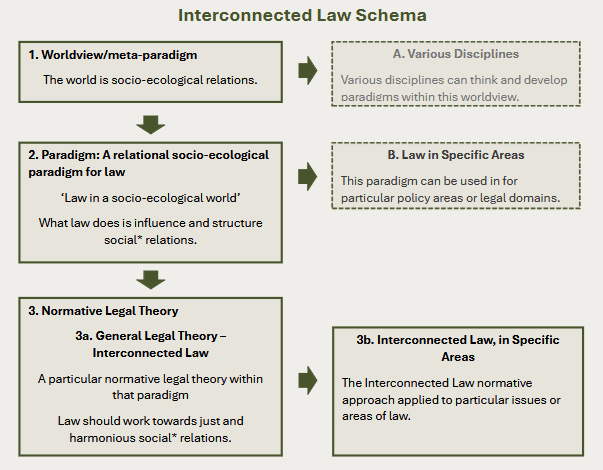
The founding conceptions are a relational worldview, social ecology, relational legal theory, and earth jurisprudence. This article offers an introductory overview. It is organised in three parts: (1) worldview and meta-paradigm; (2) descriptive legal theory; and (3) normative legal theory.
This article seeks to give a general overview of the ideas (approx. 40 mins reading time). A shorter summary version is also available: ‘A Very Short Introduction to International Law’.

Part 1: Worldview and meta-paradigm
General definition of worldview and meta-paradigm
A paradigm is a conceptual framework for how we interpret and make sense of the world, individually and collectively. Academics and authors Fritjof Capra and Pier Luigi Luisi describe a social paradigm as “a constellation of concepts, values, perceptions and practices shared by a community, which forms a particular vision of reality that is the basis of the way the community organizes itself” 1 . A worldview is broader and looser – referring to how a person, community, society, or institution conceptualises the world. Capra and Luisi discuss the meta-paradigms which pervade the paradigms of many knowledge disciplines. One meta-paradigm is described as “rationalist” or “mechanistic”, the other “systemic or holistic”. The former breaks things into parts and sees the world as a machine. The latter focuses on connections and relationships.
The socio-ecological worldview is therefore important beyond just legal thinking but for anyone who wants to understand the world!
Interconnected Law’s paradigm and worldview
The dominant paradigm in legal thinking is flawed because it is reductionist. Instead, we need a holistic alternative which rejects individualistic thinking, human-nature separation, and the distinction of social and ecological relationships. Responsively, Interconnected Law represents a paradigmatic shift to see the world as inherently relational.
The approach is rooted in a worldview that the world is socio-ecological relations: humans, society, and nature are interconnected in dense global networks of socio-ecological relations. Individuals are also part of communities and larger social structures which are embedded in nature. Our social and ecological relations are all intertwined and should be understood as socio-ecological relations.
The relational world is a founding conception of interconnected law.
Jennifer Nedelsky’s book ‘Law’s Relations’ 2 sets out the relational worldview (in the social dimension) and how this relates to law. Nedelsky critiques the dominant liberal approach to law, and constitutional and human rights, which sees humans as discrete and freestanding. An alternative relational framework sees the significance of social relations, and that there is no ‘bounded self’. This goes well beyond simply recognising that individuals experience relationships; it is “a shift in emphasis that moves relationships from the periphery to the centre of legal and political thought and practice” 3. Relationships, in this worldview, may be intimate, social, familial, or neighborly. We also have economic relationships with employers, businesses, and corporations; political relationships with representatives and governance systems; and ecological relationships with local environments, ecosystems, places food is grown, climatic conditions, and the whole planet.
There is no individual to be separated or abstracted from our relationships and relations, and conceptualisations based on these atomised individuals are therefore flawed. Almost every aspect of who we are, the world we experience and how we act is interwoven within these relations. Relationships between people and their social environment are reciprocal as each remakes the other: our relations are part of us and we are part of them. Embedded in networks of relations, we act and experience autonomy within them, whether to a lesser degree (such as oppressed) or greater degree (being enabled to flourish). She makes a distinction between the individuals’ relationships and the broader relational social structures which exist as a whole of them: an oppressive social structure such as racism is experienced personally, and as a larger social structure.
Nedelsky does recognise that “In an optimal relational approach, our place in the ecology of earth would be recognised as a relationship that shapes and is shaped by all others” 4. However, while she gives attachment points, her relational worldview lacks an ecological dimension and ecological thinking is not woven into the conception of the relational self. Hence, social ecology is integrated to ‘ecologise’ the framework in Law’s Relations. This amendment is central to Interconnected Law, an approach premised on the reality that nature is not an other, but something we are part of. As individuals and collectively, humans are interwoven into a wider ecological world, both as conditions for and influences into human life and our effects ‘out’ into the non-human world. In this sense, our social relations are all also ecological relations, as it is impossible to disentangle them. The other side is also true: that all of our effects on and relationships with non-human nature are also intertwined with our social relations. They must all be understood as socio-ecological relations.

Social Ecology forms the backdrop, the political theory and values, of Interconnected Law.
The concept of Social Ecology, formulated by Murray Bookchin in the late 1960s, inverts anthropocentrism and views society as within nature. Bookchin’s core argument is that ecological destruction is part of social domination between humans and (almost) all “environmental” issues are rooted in social relations. Given that ecological and social relationships cannot be separated, addressing ecological destruction must also address social domination, and vice versa. Ecological destruction is enmeshed in many aspects of society, relations and human activity. Bookchin wrote about the political project of building a free society, not legal theory, so Interconnected Law uses his work as a political foundation for a legal theory to grow out of. Social Ecology provides a theoretical framework to integrate existing socio-relational and ecological approaches within legal theory. Once the interconnection of the social and ecological are recognised, it becomes clear that realising human rights, and the right to a healthy environment, requires ecological integrity, which depends on sustainable social relations. A socio-ecologically holistic approach to law therefore allows for an ecological conception of human rights law, including the Rights of Nature.
Distinguishing Narrow and Broad Social Ecology
As a term, ‘Social Ecology’ contains a range of scopes of meaning. Within Bookchin’s work, therefore, I distinguish ‘narrow’ social ecology as Bookchin’s philosophy of nature and conceptual framework for understanding the relationship between society and ecology, and ‘broad’ social ecology which includes Bookchin’s political project of what to do about this. The purpose is to clarify which elements I take as foundational in my project and what I see as political commitments beyond my legal theory. My project needs a conceptual foundation, a theory of nature and society, and Bookchin’s Social Ecology, in the narrow sense, is my main substantive foundation to think about law. To be clear, this is a distinction which I am creating. These are not normal uses of the terms nor does Bookchin make this distinction. My legal theory project is distinct from Bookchin’s. It is not taking a social ecology project to law, but developing a socio-ecologically holistic approach to legal theory. This is an ‘ecologised’ extension of Nedelsky’s thinking in ‘Law’s Relations’, seeing the world as socio-ecological.
As stated, Bookchin’s work includes an analysis of existing problems in society; a conceptual framework for these problems; a critique of existing philosophy (or more generally, conceptual thinking); a normative positive vision for society; and political strategy to get there. I want to take the conceptual framework and the critique of existing philosophy, while not taking the broad political analysis and strategy or positive social vision. This quote illustrates the meaning of ‘broad Social Ecology’: “Social ecology is an appeal not only for moral regeneration but, and above all, for social reconstruction along ecological lines.” 2 The reconstruction described is both philosophical and social, a conceptual foundation and a political project.
Part 2: A relational socio-ecological paradigm for legal thinking
Interconnected Law offers a descriptive legal theory of how law influences and structures socio-ecological relations – which also implicitly critiques other legal theory for failing to see these relational dimensions. This is a formal theory (a ‘morally neutral’ case about the shape of something instead of its substance or morality) of what law does, not what it should do. The formal argument for interconnected law is: legal systems are generally based on a mistaken idea of atomised individuals which doesn’t account for the complex network of relations that make up society. Therefore, in a formal sense, law would be a better “tool” if it were based on realities of interconnectivity and relationality. This argument means that even if you don’t agree with my values, principles, analysis and application, there is still something in Interconnected Law for you.
What does law do? Law is a social institution of power, but it is more than just a top-down state power or governance system. It claims and is usually viewed with some legitimacy for people adopting legal norms voluntarily, not only due to legal coercion. It is a site of contestation and conflict, and (to some degree) includes challenges to existing power structures and flows while also reproducing them. Our legal system is an interwoven part of our society and economy. It structures and influences human activity and relations, through how people understand the world, gentle social reproduction of relational patterns, and firm coercive enforcement of particular relational structures and behaviours.
As such, the law has a significant role in constituting and reproducing society, giving us frameworks to interpret ourselves and the world. For instance, our legal systems designate land, animals, and ecosystems as objects which humans are empowered to destroy and plunder. In doing so, our legal system codifies a division between humans and nature and perpetuates extractive activities by reinforcing the socio-cultural norm of human separation from nature. As another example, the law takes individual (and corporate) rights as the primary building block, which reproduces individualistic conceptions of society. We see freedom as something we want for ourselves, not something created together.
Though we often name politics, society, culture, economics and even art as separate domains, these are all interwoven, and law is a pervasive part of this jumble of human activity. Despite that, law has mostly faded into the background, seen as a neutral and technical social system instead of a powerful influence in our way of life. To better reflect the world, Law should take complex interconnection as its basis, becoming a more conscious and active part of the web of relationships it already exists within, influences, and structures. These interconnected relations can be empowering and sustaining, or harmful and destructive. Law, as part of this, can be used to oppress people or to liberate them. To be clear, the argument is not that law should be used to influence these relationships, and nor is it that law is the only way we should do this. Instead, in the relational understanding, the law already influences relationships. This descriptive, value-neutral, theory is useful for anyone working with or about law, as it is about law as an instrument. That said, the approach is incomplete until we add a value-based framework for what law should do.
For more about law’s role in producing and reproducing social relations, see Jennifer Nedelsky’s ‘Law’s Relations’, from which I draw heavily here – adding only the expansion along the ecological dimension.
Part 3: Normative Legal Theory
3a. General Legal Theory – Interconnected Law
Interconnected Law creates a normative, value-based, framework in which law should be used as a tool with a goal to make socio-ecological relations more just, harmonious, and empowering as part of a Whole Earth Community. To determine what is just and harmonious, Interconnected Law takes a series of normative values as its foundation. These include, ecological ethics in the form of earth jurisprudence; ethics of care; and social justice ideas including broad social ecology, communitarianism, collective anarchism, and liberation politics. Combining the functional theory of law in a socio-ecological world with these values creates a full legal theory.
Changing Law’s Role in Society
Instead of seeing law as protecting individual negative liberty, I see law as mediating interwoven relations in society. Law therefore ought to structure relationships justly and ultimately better realise human freedom by protecting and empowering people. For instance, seeing law as having an active role to play in the network of relations suggests a more active role for the judiciary than is currently the case. If we acknowledge that adjudicating and resolving cases includes moral and political reasoning, and that law is about strengthening relations, then this ought not be done solely technocratically by judges. An interconnected approach would include ideas such as alternative dispute resolution, community engagement in resolving conflicts, and more non-judicial involvement in decision making such as juries, citizens assemblies and stakeholder representatives.
Talking of a ‘changing role’ for law in society, it is worth saying this approach is designed for people in a western liberal capitalist democracy, specifically the UK and USA. Interconnected Law is a development from within, recognising our cultural and historical conditions and moving from where we are into a better tomorrow. It draws out of the existing developments from science, queer and feminist theories, political currents and romantic approaches to nature within our culture. In short: it is neither a universal idea about law nor a vision of the final goal of law, but one for western liberal capitalist societies now and for the near future.
What is just and harmonious?
Alone, the aim for law to create more just and harmonious socio ecological relations would be too vague. Hence, the approach is guided by an ‘interconnected’ paradigm of normative theories of justice including earth jurisprudence, ethics of care, and social justice approaches including broad social ecology, communitarianism, collective anarchism, and liberatory politics. Broadly, these concepts and their value-systems can be adapted for a range of contexts and come under an umbrella of ‘relations of freedom’. The approach is given normative substance by social justice ideas including equality, autonomy (people should have control over, and think about, their lives collectively, not individually), and democracy (which should be based on multi-level engagement).
Law can be part of reproducing the neoliberal vision of individuals in society who only deserve things through productive economic activity. Alternatively, with a relational approach law could reproduce a more just and harmonious vision of society. These ideas are not just legal, but law is certainly a necessary part of (re)constituting how we see ourselves and each other. When we think relationally, we can see law’s pervasiveness – transcending the Western tendency to focus on designation of illegality, imposed obligations, threats of imprisonment and financial sanctions. Often, the possibility of such a sanction, via lawsuits or prosecution, is enough for people to comply. In many situations people in Western liberal democracies accept law as their guide because they think it is the right thing to do– indicating law’s soft power.
3b. Interconnected Law, in Specific Areas
Human rights theory and practice: Socio-Ecological Human Rights
Interconnected Law thinking can be applied to Human Rights theory and practice to develop a socio-ecological approach to human rights. Traditional approaches to human rights and human rights law are based on an abstracted bounded individual subject – atomised out of social relations and separated from any ecological world. Each of these dimensions has been challenged by critical scholarship, but has not yet been combined into a socio-ecological relational approach.
The relational critique (i.e. Nedelsky’s Law’s Relations) shows firstly, that the theoretical ‘bounded self’ does not exist but rather that all individuals exist and emerge out of social relations, and secondly, that it is not possible to realise human rights fully at the individual scale. Instead, what is needed are the social relations within which these human rights are experienced or realised. The same is true ecologically. While the Right to a Healthy Environment has now been recognised, with the understanding that humans cannot survive or flourish without a healthy environment, an overarching ecological approach to human rights remains undeveloped.
There is therefore a need for human rights theory based on a conception of the socio-ecologically interconnected individual, as the foundation for a human rights practice which can realise human rights properly. Liberal human rights function in the same way as supporting an endangered bird just with nest boxes: there is also a need for a safe habitat with adequate food, not only a good nest. Individual humans can only experience fully realised human rights if they live in a just society and a healthy ecological world.
The purpose of human rights law and policy is to realise human rights for people – which means to develop a world within which individuals experience human rights. Human rights laws should therefore work not only at the individual scale but at the systemic or social scale, transforming socio-ecological relations. It is perhaps most obvious that human rights cannot be fully realised only at the individual scale with socio-economic rights. Rights to housing or healthcare or food require functioning systems within which there is housing, healthcare and food for individuals. This is perhaps taken for granted in ‘developed’ economies where these are generally sufficiently accessible for many, and only lacking for a smaller proportion of individuals and communities. It should be recognised, however, that these each need to be realised at a social scale – and that each has environmental dimensions too. A healthy environment must be realised at the ecological scale, not the human scale. Even individual private property and the so-called ‘free market’ require strong social bonds or modern state institutions to be secured. Equality cannot be realised only at the individual scale with individual rights such as non-discrimination, but requires unequal and unjust social structures to be transformed. Yet it is just as true that traditional liberal values are relational, experienced in social relations and to be fully realised must be addressed at the social scale. This argument is well made by Nedelsky in Law’s Relations, showing that autonomy requires a relational social context which fosters autonomy. I extend this argument to encompass the ecological dimensions for a socio-ecological approach.
The recognition that it is living within a socio-ecological relational context which enables individuals to experience a high level of human rights shifts our focus from trying only to protect the rights of individuals at the individual scale (as is the liberal tradition) to developing these social relations. Human rights law includes positive obligations on the state – and very occasionally private actors – and these should be further developed. The common critique of liberalism as ‘rights without responsibility’ highlights this, as there is certainly an imbalance both in our legal system and our culture. Current human rights include lots in the way of demands on the state from the individual citizen, but much less in the way of responsibilities; either civic responsibilities or in private law to other citizens. Ecological responsibilities are vitally important too, as without caring for the environment and acting sustainably, there cannot be a healthy environment within which humans can live. Relational responsibilities and an ethic of care towards others are needed to establish a just social fabric, and human rights law and policy should think about how to foster such care relations.
Beyond state and individual responsibilities, human rights responsibilities of business enterprises are particularly important to consider in our current social orders. Instead of simply freedom to operate within regulatory limits, the idea of them having responsibilities to respect human rights within their spheres of influence is becoming more recognised. Large corporations have huge influence over the lives of their employees, and often too on communities and societies where they operate, particularly in jurisdictions with weaker state institutions where companies can even be more powerful than states. Here, supply chain responsibilities can go some way to addressing this imbalance. Beyond not violating human rights, there should also be consideration of positive responsibilities. Business enterprises have (or ought to have) civic responsibilities and have a positive impact on society, which could include their activity being net socially beneficial (as well as not ecologically damaging), or fostering positive impacts and greater realisation of human rights within their spheres of influence. As part of this, the political influence of corporations also needs consideration too. There are no simple answers or legal interventions here, but the guiding questions are around the civic responsibilities of large business enterprises and how the legal system can help work towards more just social relations within which human rights can be further realised.
Interconnected Law’s holistic approach, seeing the rights subject as socio-ecologically embedded, allows human rights, ecological integrity, and Rights of Nature to exist and develop in harmony instead of in contention. All can work together towards socio-ecological justice: securing a healthy environment for humans should go hand-in-hand with benefits for non-human nature, just as environmental protection should also come with social justice. ‘Green’ human rights should be ecologically beneficial, not destructive. A word of caution on that note – it is possible to have an approach to law which includes relations with the environment, recognising that humans are ecological beings which depend on various relations with our environment to survive and thrive, which remains anthropocentric in value and reduces the natural world to serve humans. Or in other words, a structurally socio-ecological (i.e. in the paradigm) approach to legal thinking but with ecologically destructive values.
Socio-Ecological Environmental Law and Rights of Nature
Socio-Ecological Thinking and Environmental Law
Environmental law is a heterogenous grouping which includes many different issues and approaches. Those outside the discipline should understand that much of environmental law is not ecologically positive, but about facilitating and managing ecologically destructive practices based on human domination of and supremacy over the rest of the natural world, and even protection and conservation elements sometimes contain compromises.
Interconnected Law prompts us to think in terms of socio-ecological relations, coming from the key insight of Social Ecology that any environmental relations are intertwined with social relations. Ecological and environmental thinking is necessarily relational because ecology is relational and thinking about the environment is thinking about human relationships to it. There is environmental law scholarship – such as socio-legal and political ecology approaches – which could be considered to be relational and perhaps sometimes even falling within a socio-ecological paradigm. Yet most legal thinking is still rooted in conceptions of humans as fundamentally separate from nature, and often does not understand humans as socially relational. It is vital to include these understandings in the relational conception, and recognise that all of these relations are interconnected socio-ecological relations.
Interconnected Law thinking regarding environmental law is therefore very useful for analysing environmental issues, critiquing environmental law and regulation, implementation and efficacy of existing regimes, and developing better approaches. Any environmental issue is a complex relational web of various actors and effects, with interwoven social and ecological causes and effects. Law is involved (typically in multiple ways) in producing, structuring, facilitating and managing this relational web. Environmental law thinking should therefore focus on the particular socio-ecological relations around an issue, the underlying social causes, and how legal interventions seek to transform these social relations. Some more complex environmental regulation regimes which take a systemic approach can easily be understood in this way, and may indeed have been consciously designed in a relational manner.
Many activists and conservationists might think that criminalisation or simple permissive regimes may address an issue. Yet beyond the problems of the need for strong institutions and enforcement, for many things prohibition and policing only go a small way in countering the drivers and social causes. For example, if there are competing land uses, where there are local people who need to feed themselves or somehow earn a living, they may not have much choice. Or, at the other end of the scale, large businesses may see dodging fines simply as a cost of doing business, with huge amounts of profit to be made from cash crops to export to wealthy foreigners with ever-increasing demands and standards of living. These problems are more significant in countries with less strong state institutions, but fundamentally the same everywhere. Similarly, legal designations for particular habitats, ecosystems and species might be thought to solve an issue, and campaigners will often push hard to get some aspect of nature designated. However, this must always be seen within the broader social context: the social transformation of the web of relations which cause the particular problems sought to be addressed. It is therefore imperative for environmental campaigners to think carefully about the social (and socio-ecological) relations in play, and build alliances where possible. As is now well-recognised, social justice and ecological problems are very much intertwined, meaning that often working towards ecological justice gives opportunities for (and in some cases necessitates) also working towards social justice.
Earth Jurisprudence
Earth Jurisprudence is the most developed ecological approach to law and is thereby the best to weave into a socio-ecologically holistic approach to law. It is a relational approach of sorts, being about relationships between humans and the rest of nature, but it does not include much in the way about social politics or include a relational conception of humans and society. Earth Jurisprudence is a response to current legal systems which conceptualise humans as separate from the rest of nature, and in which (non-human) nature is insufficiently protected and features primarily as property without inherent values or legal subjecthood. Earth Jurisprudence argues that law is not just a neutral tool and goes beyond saying that environmental law has failed to prevent ecological damage and degradation, instead claiming that law facilitates the destruction. Ecological destruction is not just an economic, political or cultural problem with law as a neutral medium. In Cormac Cullinan’s words: “one of the primary causes of environmental destruction is the fact that our governance systems are designed to perpetuate human domination of Nature, instead of fostering mutually beneficial relationships between humans and the other members of the Earth community.” 6
Cullinan proposes that the legal system should work to secure ecological integrity and sustainable relationships between humans and ecological systems by including aspects of (non-human) nature in the legal system as rights subjects with rights and interests. As well as this, the values of the legal systems should include ecological integrity, sustainability, valuing (non-human) nature and rejecting human domination of the rest of nature. The legal system and other governance systems should instead function to work towards harmonious relationships with the rest of nature, instead of domination and extraction. The idea of relational responsibility is also key: an ecological ethic of care that our relationships with non-human nature humans should involve responsibilities, not only rights. The critique of our dominant legal systems having too much of ‘rights without responsibilities’ is present here too, with large corporations highlighted as having rights to property and to act for a profit, but without counterpart responsibilities.
One key element of this is ‘Rights of Nature’ (RoN), which is the idea that non-human elements of nature (such as species, rivers, ecosystems, habitats, communities of animals, etc) have moral rights and should have legal rights and subjecthood. The crucial point of this is that the rights are in the interests of elements of nature – unlike much of environmental law which either serves human interests or is an implementation of some sort of balance struck between human interests and ecological harm. Whereas environmental regulation is piecemeal, Rights of Nature can function to create a baseline of protection against interference. Rights of Nature are being implemented around the world, in constitutions, legislation and case law in countries including Ecuador, Bolivia, New Zealand, India and North America. The UN’s Harmony with Nature programme has also championed the idea, and it continues to gain traction. While this approach may seem radical, it is arguably the best way to realign our legal systems with the sort of far-reaching transformations that are needed for ecological protection and sustainability.
Socio-ecological Development of Rights of Nature
Earth Jurisprudence and Rights of Nature approaches have generally been partial, lacking meaningful consideration of social justice, political dynamics, and just inter-human relations. They are about relationships between humans and the rest of nature, and tend to be framed in terms of moral, cultural, and spiritual transformation. We therefore need a broader approach to encompass the interconnectivity of socio-ecological relations. Interconnected Law is intended to help us move towards societies where humans live in harmony with the rest of nature and have sustainable relations which reflect the particular social context. Ultimately the entire (legal) system must be transformed, and a critique of law’s role in ecological destruction must also critique law’s role in social domination, and address the intertwined social forces driving ecological destruction.
The main ‘orthodox’ Rights of Nature position is rooted in either some form of ‘natural law’ argument or follows liberal thinking and extends liberal approaches to rights to nature-subjects. This is a huge step forward, as Rights of Nature function in the interests of nature-subjects against negative effects from humans (and can include positive dimensions to require action too), and strong Rights of Nature should affect human activities and behaviour. Yet it is crucial to deepen this analysis and explore how these rights function to restructure the socio-ecological relations in human social orders which drive the ecological harms. Campaigners must remember that simply establishing rights in law is not the goal in itself, but only the means with which it is hoped to protect (non-human) nature. Rights of Nature advocates would also do well to bear in mind the mixed legacy of human rights, which often fail to achieve emancipation or social transformation, and learn from critical human rights scholars. The key issue is therefore to consider how legal rights will change the underlying social relations, and legal interventions should have this in mind. The role of state institutions should be carefully considered, and in many cases it will be important to have democratic and decentralised representation for nature-subjects instead of relying only on bureaucratic methods of implementation.
Rights of Nature legal theory remains relatively undeveloped, including as to the nature of the rights. Ideas of rights rooted in liberalism have often been drawn from, yet these are flawed (as discussed above in the section on human rights); aimed primarily at securing individual freedom at the individual scale. For Rights of Nature (as also for human rights), it is vital to think in relational and ecological terms. This is obviously necessary for understanding when the rights may be interfered with and what they demand, because nature-subjects are all about ecological relations and clearly not a ‘bounded self’ as in liberal human rights theory. Yet it is also important for how the rights are conceptualised. Whereas traditional human rights were absolute, more recent jurisprudence (such as Kai Möller’s Global Model of Constitutional Rights) has developed for quantified human rights where interferences can be justified. Competing rights-interests are ‘balanced’ against each other, and the rights are effectively on a spectrum of intensity where the closer to the ‘core’ of a right an interest is, the stronger the weight it has. Implementing Rights of Nature in this way may be the only sensible way to operationalise them, both for themselves and structurally for the inevitable rights-conflicts with human rights and human interests. Of course, the danger (whatever form the rights might take) is that they might have formal legal recognition but not have any substantive effect, with judges giving human interests precedence over those of nature-subjects and the destructive status quo prevailing. This can be addressed by adding normative depth in legislation (or else hope it develops in case law) to give guidance to judges on how to resolve the conflicts of competing interests and ensure an ecological ethic prevails.
This highlights the needs both for a socio-ecological approach by Rights of Nature campaigners and for an ecological ethic to be taken across the whole of a legal (and political) system. Rights of Nature interventions must consider how they will change the underlying social relations which are driving the ecological harms. These are usually complex relational webs in which human interests, ecological harms, harms to human health or other human rights, social injustice and social relations are all intertwined, and Rights of Nature can be on any side of social conflicts. Local communities (or a portion thereof) might be pitted against an external extractive industry, or local communities may be causing ecological harms in land use or extractive practices, and state institutions can be on either (or both) sides of this. The social forces of large corporate entities will need to be tackled too, with Rights of Nature being one possible way to do this. External liability can make a big difference where enforcement and implementation is strong, but ultimately it is internal practice and values which need to be changed.
Working towards ecological justice often gives opportunities for also working towards social justice – and in some cases necessitates this, if unjust social relations are contributing to driving the ecological harm. Rights of Nature campaigners should therefore consider carefully how the rights will interact with these social relations and how they might transform the underlying drivers. There will often be possible alliances between nature-interests and related social justice issues, as well as conflicts with existing human interests to mitigate, and adversarial dynamics to overcome, and working as part of broader social movements will be key. Working with local communities will be crucial, including trying to avoid the ‘conservation’ dynamic where people embedded in a place are removed and instead moving towards harmonious relationships between local communities and their environments.
Ultimately, strong ecological protection (as can be provided by strong Rights of Nature) implementation is beneficial and necessary for humans (though these laws are not for humans). Though in the short term there may be conflicts and difficulties in transformation to sustainable ways of living, humans cannot live without a suitable healthy environment, and environmental problems usually further exacerbate social injustices. A healthy environment must be secured at the ecological scale; it is nonsensical to try and implement it at the individual or human scale. Here, there is a necessary nexus between the human right to a healthy environment and Rights of Nature, which can secure the ecological integrity which humans depend on.
For more of my work on Rights of Nature, see https://interconnectedlaw.com/category/rights-of-nature/.
3c. Law in Specific Areas
At this stage, Interconnected Law exists primarily as a conceptualisation of law’s role in our society and how it should be. While this is far from a detailed blueprint, it is helpful to share some sketches of how things might be in a legal system based on this paradigm. For myriad policy areas and legal domains, the approach’s socio-ecological paradigm would start by understanding the conditions and relations at play, mapping how they should be transformed to be more just, balanced and harmonious, and finding how law can be part of this. These transformations may also require changes to political power, social relations and cultural norms. As such, we should look at law as both a catalyst to change broader norms and something which itself needs transforming.

In general, law’s goal should be to improve the web of relations we live in instead of trying to achieve goals via abstracted individual rights. When we want to realise freedom, for example, we should be looking to create and cultivate relations that empower people and foster freedom. Freedom should be talked about in terms of conditions and relations instead of trying to crudely manifest freedom individually. Similarly, sustainability policies and law should be formed with a relational lens: when we talk about ecological sustainability, that is a relational question between actors and Nature at all levels: individuals, corporations, geographic areas, communities, nations and economic systems.
For property law, an interconnected approach would find the relational context of the property ownerships and ask what it would mean for these relationships to be just. The ‘ownership as absolute control’ model allows for injustices for those affected by property ownership, and there should instead be responsibilities involved as a bundle of rights and responsibilities. This ought include social responsibility, such as a responsibility to the local community that land is used in line with the public interest, which could be determined by a democratically-created policy like a council’s housing strategy. It would also include ecological responsibilities, meaning that ownership would be transformed to something more akin to ‘stewardship’. Ownership of land containing habitats could have a general legal responsibility that ecological health is maintained – and of course various positive responsibilities could also be included depending on context, such as in relation to Rights of Nature.
Corporate law has the same fundamental problem as our general approach to liberty: it creates power without responsibilities. Regulation of corporate activity currently primarily has piecemeal limits of corporate conduct, such as specific pollution control regimes or a requirement to publish a statement about addressing modern slavery. An interconnected approach would be more transformative, seeking to fundamentally change this dynamic in recognition of civic duties that business enterprises have (or ought to have) as part of society. Reform could be approached by mapping out the different relationships and impacts that corporations have and asking what legal changes are needed for these relationships to be more just.
The idea of a ‘triple bottom line’, where a company measures social and environmental impacts as well as financial performance, could become a legal framework instead of a voluntary approach, turning the different impacts that businesses can have into legal parameters for legitimate business activity. A company could be required to be socially beneficial both in general and to communities particularly impacted by its operations. It could be required to be responsible for respecting and furthering human rights in its supply chain; to be fair to its employees; and to have a positive (or at least sustainable and not negative) ecological impact. In some ways this is comparable to the idea of a ‘duty of care’, mapped out for the different power relations which a business enterprise has, and going beyond simply avoiding negative responsibilities to also include some positive responsibilities. Creating these legal responsibilities as external regulation could have a huge effect on reflexively changing business practices, but it may ultimately be that these need to be internalised into the governance structure of large corporate entities so as to counterbalance the board of directors whose primary motives are usually generating profit for shareholders. Civic representatives could be required inside a governance structure to represent the interests of society as a whole, employees, and the natural world. While this thinking may seem a radical reform of business enterprises’ role in society, it is generally recognised as unjust to profit while harming others – and ecologically, this is parasitic behaviour. This sort of change is necessary to catch up to the huge size and power that large corporate entities have.
Criminal law: The liberal approach to crime sees an individual who has committed a bad act and needs to be punished and rehabilitated. It does not consider relational context, and therefore focuses on policing crime in an abstracted way. Instead, we should situate the ‘crime’, the perpetrator and the harm caused in its relational context. Looking at socio-economic causes of crime and the ‘public health’ approach is part of a relational approach to the context of why people commit crimes. The ‘public health’ description is often described as ‘treating violence like an infectious disease’, but it could be described as being about circumstances and relationships which cause or reproduce violence. This looks at changing outcomes and makes more obvious behaviours which should be dealt with by means other than criminalisation, such as recreational drug use and rough sleeping. Grounding the discussion of crime in interconnection helps remind us to focus on what we are trying to achieve. We should not be aiming to catch criminals, or even for there to be an absence of crime, but to realise security and wellbeing. These are values which are best understood relationally: security is not about protecting ‘good people’ from ‘bad people’ but about relationships of security which give- conditions of safety.
Restorative justice and transformative justice are both relational approaches to criminal justice, shifting the focus away from an individual’s actions to instead look at relationships. Restorative justice focuses on the harm caused by particular behaviour(s) and tries to repair this damage, involving the perpetrator in a process which hopes to be positive for them too, as well as restoring the relationships with and in the community. Transformative justice is about changing the conditions which cause crime, rooted in transforming community infrastructure and relations into ones which produce safety and care instead of harm and isolation, and seeking to avoid reproducing violence and harm in this response.
To summarise
Interconnected Law provides a framework for others to apply a socio-ecological legal paradigm to specific policy areas or legal domains. This combines a descriptive theory of how law works and how to better use law, with a normative value-based framework of how law should be used to make socio-ecological relations more just and harmonious by focusing on relationships. The idea is not that law alone can save us. Our law should shift to looking at relationships, such as between humans and their ecosystems, instead of just being about individual rights and rights-claims.
This approach has the potential to help change how we relate to each other, seeing ourselves collectively instead of individually. Interconnected Law is a vision for how law itself should be transformed to address injustices. The argument is certainly not that law should be the main way we try to change society, but that law must itself be part of the broader political and social transformations, and a part which has so far been overlooked. I hope that Interconnected Law will be useful to a range of social movements as we seek to realise better worlds. This is a radical approach to law, and I anticipate that many will respond by saying ‘it’s a nice idea, but that isn’t what law is’. My response to that is: this is what the law could be, and radical is what is needed.
Editorial Notes
- This article was written as part of my medical retirement after becoming severely ill due to post-covid syndrome (aka ‘long covid’). and aims to present the legal theory ideas I was working on before becoming ill. The article was primarily written by a research assistant (Lucy Gavaghan) based on existing writings and notes. Some parts have not been reviewed by me (Alex May), though I expect they reflect my views well and all responsibility remains mine.
- Inevitably, I am not ‘satisfied’ with this piece as I have an awareness of how it ‘should’ have been more – more complete, more detailed, etc. But that’s the crux of the work being interrupted by illness. Perhaps this article also falls short of the full academic standard of presenting these ideas, such as referencing or engaging with existing work and ideas – but this was not possible and the aim was primarily just an exposition of this thought.
- An earlier version of this article was published on 24/03/2026. A revised second version was published on 23/6/26 in which I expanded section 3b to add my condensed thoughts on human rights and rights of nature which were likely to become chapters of my PhD thesis. A few small additional revisions were made with a final third version on 17/7/206.
- In case anyone is interested, some more detailed but unpolished writing can be found in the archive of my PhD notes.
- My own dissemination of this work will be very limited, so if you think it useful and of merit, please do assist in sharing it around. Anyone who wishes to work with any of my work is more than welcome to do so; it is published under a Creative Commons attribution licence.This work is licensed under the Creative Commons Attribution-NonCommercial-NoDerivatives 4.0 (BY-NC-ND) which means that the text and graphics may be used for non-commercial purposes, provided credit is given to the author.