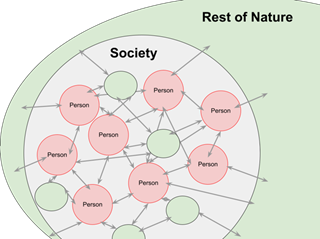
This article was originally written as a section of my piece Interconnected Law: socio-ecological thinking about law (An Overview), but I thought it deserved a stand-alone blog post too The underlying idea of Interconnected Law and socio-ecological relations is therefore absent here. To give a brief summary: humans, society, and nature are interwoven in dense networks of socio-ecological relations. Individuals do not exist as atomised bounded selves but are inseparable both from social relational webs and the ecological world we live in.
For those who would prefer a downloadable version of this article, here’s a .doc and .pdf:
A Socio-ecological Approach to Human Rights
Interconnected Law thinking can be applied to Human Rights theory and practice to develop a socio-ecological approach to human rights. Traditional approaches to human rights and human rights law are based on an abstracted bounded individual subject – atomised out of social relations and separated from any ecological world. Each of these dimensions has been challenged by critical scholarship, but has not yet been combined into a socio-ecological relational approach.
The relational critique (i.e. Nedelsky’s Law’s Relations) shows firstly, that the theoretical ‘bounded self’ does not exist but rather that all individuals exist and emerge out of social relations, and secondly, that it is not possible to realise human rights fully at the individual scale. Instead, what is needed are the social relations within which these human rights are experienced or realised. The same is true ecologically. While the Right to a Healthy Environment has now been recognised, with the understanding that humans cannot survive or flourish without a healthy environment, an overarching ecological approach to human rights remains undeveloped.
There is therefore a need for human rights theory based on a conception of the socio-ecologically interconnected individual, as the foundation for a human rights practice which can realise human rights properly. Liberal human rights function in the same way as supporting an endangered bird just with nest boxes: there is also a need for a safe habitat with adequate food, not only a good nest. Individual humans can only experience fully realised human rights if they live in a just society and a healthy ecological world.
The purpose of human rights law and policy is to realise human rights for people – which means to develop a world within which individuals experience human rights. Human rights laws should therefore work not only at the individual scale but at the systemic or social scale, transforming socio-ecological relations. It is perhaps most obvious that human rights cannot be fully realised only at the individual scale with socio-economic rights. Rights to housing or healthcare or food require functioning systems within which there is housing, healthcare and food for individuals. This is perhaps taken for granted in ‘developed’ economies where these are generally sufficiently accessible for many, and only lacking for a smaller proportion of individuals and communities. It should be recognised, however, that these each need to be realised at a social scale – and that each has environmental dimensions too. A healthy environment must be realised at the ecological scale, not the human scale. Even individual private property and the so-called ‘free market’ require strong social bonds or modern state institutions to be secured. Equality cannot be realised only at the individual scale with individual rights such as non-discrimination, but requires unequal and unjust social structures to be transformed. Yet it is just as true that traditional liberal values are relational, experienced in social relations and to be fully realised must be addressed at the social scale. This argument is well made by Nedelsky in Law’s Relations, showing that autonomy requires a relational social context which fosters autonomy. I extend this argument to encompass the ecological dimensions for a socio-ecological approach.
The recognition that it is living within a socio-ecological relational context which enables individuals to experience a high level of human rights shifts our focus from trying only to protect the rights of individuals at the individual scale (as is the liberal tradition) to developing these social relations. Human rights law includes positive obligations on the state – and very occasionally private actors – and these should be further developed. The common critique of liberalism as ‘rights without responsibility’ highlights this, as there is certainly an imbalance both in our legal system and our culture. Current human rights include lots in the way of demands on the state from the individual citizen, but much less in the way of responsibilities; either civic responsibilities or in private law to other citizens. Ecological responsibilities are vitally important too, as without caring for the environment and acting sustainably, there cannot be a healthy environment within which humans can live. Relational responsibilities and an ethic of care towards others are needed to establish a just social fabric, and human rights law and policy should think about how to foster such care relations.
Beyond state and individual responsibilities, human rights responsibilities of business enterprises are particularly important to consider in our current social orders. Instead of simply freedom to operate within regulatory limits, the idea of them having responsibilities to respect human rights within their spheres of influence is becoming more recognised. Large corporations have huge influence over the lives of their employees, and often too on communities and societies where they operate, particularly in jurisdictions with weaker state institutions where companies can even be more powerful than states. Here, supply chain responsibilities can go some way to addressing this imbalance. Beyond not violating human rights, there should also be consideration of positive responsibilities. Business enterprises have (or ought to have) civic responsibilities and have a positive impact on society, which could include their activity being net socially beneficial (as well as not ecologically damaging), or fostering positive impacts and greater realisation of human rights within their spheres of influence. As part of this, the political influence of corporations also needs consideration too. There are no simple answers or legal interventions here, but the guiding questions are around the civic responsibilities of large business enterprises and how the legal system can help work towards more just social relations within which human rights can be further realised.
Interconnected Law’s holistic approach, seeing the rights subject as socio-ecologically embedded, allows human rights, ecological integrity, and Rights of Nature to exist and develop in harmony instead of in contention. All can work together towards socio-ecological justice: securing a healthy environment for humans should go hand-in-hand with benefits for non-human nature, just as environmental protection should also come with social justice. ‘Green’ human rights should be ecologically beneficial, not destructive. A word of caution on that note – it is possible to have an approach to law which includes relations with the environment, recognising that humans are ecological beings which depend on various relations with our environment to survive and thrive, which remains anthropocentric in value and reduces the natural world to serve humans. Or in other words, a structurally socio-ecological (i.e. in the paradigm) approach to legal thinking but with ecologically destructive values.
Editorial Notes
- This article was written as part of my medical retirement after becoming severely ill due to post-covid syndrome (aka ‘long covid’). It aims to present the ideas I was working on before becoming ill — the socio-ecological approach to legal thinking being the theme of my PhD thesis, with human rights looking to be a chapter of this about human rights and applying this legal theory to it. Due to necessity, these are condensed thoughts which perhaps fall short of the full academic detail and referencing.
- The book referenced is: Jennifer Nedelsky, Law’s Relations: A Relational Theory of Self, Autonomy, and Law (Oxford University Press 2011).