Report: ‘Realising Rights of Nature: Conceptual Foundations for Legislation’

On the 19th May 2026, Lawyers for Nature published a new report by Alex May called “Realising Rights of Nature: Conceptual Foundations for Legislation”. Their announcement blog introduces it as follows:  

“This is a follow on from a previous report titled “Realising Rights of Nature: Understanding the Variety of Legal Instruments”, which set out the different types of Rights of Nature legal change: Constitutional Change, Legislative Framework, Element Specific Subjecthood, Litigation and Common Law Principles. 

The new report seeks to map out the breadth and depth of what Rights of Nature legislation could cover, including the different elements which a legislative framework would need, the different dimensions of rights and subjecthood, the different legal effects and areas of law which could be included, alongside some possible legislative models. Much of this is relevant for anyone thinking about how best to implant Rights of Nature.

Alex explained that the germination of this project was the question: what could Rights of Nature legislation in the UK look like? This report does not set out to fully answer this question, but seeks to provide the groundwork for consideration of what form legislative frameworks could take and the contents they might have. There is not one way to bring about Rights of Nature – which is, ultimately, about transforming the breadth of a legal system and relationships with more than human life across society. Instead of one linear route, there are a few dimensions and directions which can be implemented to different intensities and degrees.”

The Lawyers For Nature Introductory article continues:

“For the most part, the work is more like different parts of a jigsaw puzzle which compliment each other, rather than competing choices. Ultimately, Rights of Nature seeks to change the dynamic of a legal system so as to cover the various social relations with the more than human. While this would require transformation and legal change on a huge scale, it can be done incrementally and programmatically, as shown in this report. There are various ways in which legislation could end up having little meaningful effect, being formal rights that have no substance, or no teeth, or nature-subjects cannot be meaningfully represented, or other such pitfalls. The report covers the foundations, legislative elements and effects, case studies and legislative models.

During the course of writing this report, Alex became severely ill with acute post covid syndrome. The ‘Author’s Note’ (section 1.4) and ‘Methodology and Disclaimer’ (section 2.2) explain the impact of illness on Alex’s ability to work. As a result, the report represents a culmination of Alex’s years of research and writing, but is not complete. Particularly, sections 4 and 5 (‘Case Studies’ and ‘Comparative Analysis’) are incomplete, but have been left within the report. Alex explains that this was  for a number of reasons: it recognised the unfinished nature of this report (and in a way honoured his life being interrupted by severe illness); it felt more cohesive to the structure and idea of the report; and it allows for others to feed into this part of the work. 

Alex has expressed that anyone who wishes to work with this report is more than welcome to do so (with appropriate acknowledgement or credit), whether in blog posts, articles, chapters or in presentations. The report is published under a Creative Commons licence. We also encourage anyone who would like to work on Section 4 or 5 to reach out to operations@lawyersfornature.com with an expression of interest. This is an incredible piece of work and certainly worthy of further exploration.”

The blog concludes:

“We would like to thank Alex for his excellent work under such challenging circumstances. We hope this report will be useful to many of you and will contribute to the on-going discourse surrounding the Rights of Nature in the UK and beyond. You can download the report here.

See below for a contents overview and an excerpt from the Executive Summary.

  1. Introduction section (p.4 – 19) – Contents; Executive Summary; Schemas; Thematic Overview, Substantive Points and PItfalls; Authors Note.
  2. Foundations (p.19 – 39) –  An Overview of RoN; Methodology and Disclaimer; Subjecthood on a Spectrum; Understanding Rights.
  3. Legislative Elements and Effects (p.45 – 84) – This covers the five different elements of Rights of Nature legislation: Subjects; Rights; Obligations and Different Legal Areas; Enforcement and Representation; Other Legal Effects. The subsection on legal effects covers: considerations for the state; constitutional-style rights; private law effects with civil obligations and/or effects on landowners; and the  incorporation of nature-subjects as legal entities.
  4. Case Studies (p.84 – 99) – This looks at Rights of Nature legislation which has been proposed or introduced: Western Australia, Federal States of Australia; Bolivia; Peru; Panama; Uganda; Spain, the Mar Menor.
  5. Comparative Analysis (p.99 – 100) –  Section 5 is intentionally blank (see explanation in 1.4 Author’s Note and 2.2 Methodology and Disclaimer)
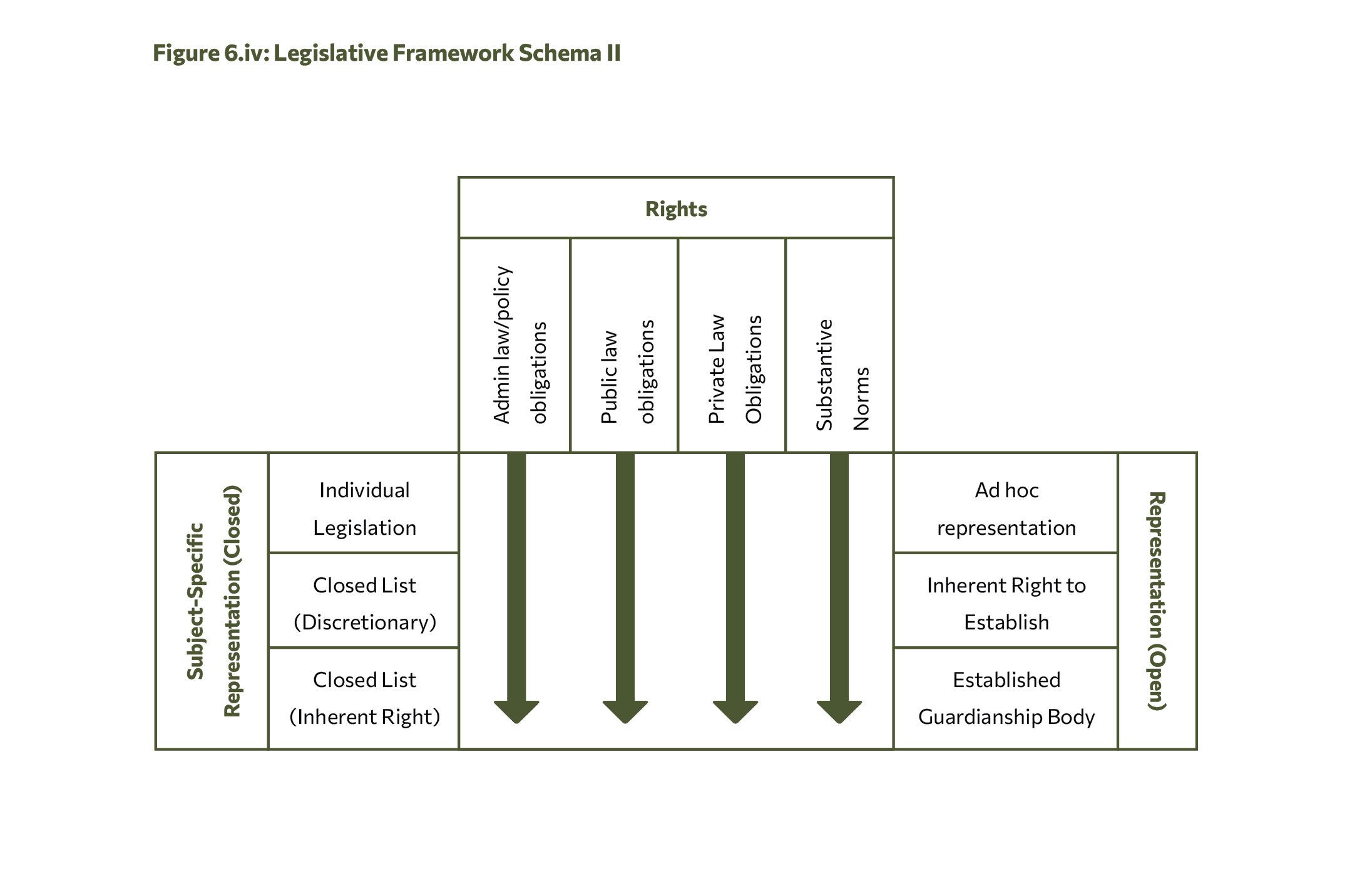
  6. Legislative Models (p.100 – 105) –  sketches out different models and options for Rights of Nature legislation in the manner of a simple blueprint or building blocks: Overview of Different Approaches; General Rights; Subject-Specific Representation; Combined Hybrid Approaches.

Executive Summary Excerpt  

“This report seeks to cover the substance of what Rights of Nature legislation might contain. In doing so, it contains a combination of conceptual and substantive content and schemas for the elements of legislation and different legislative models. It does not seek to propose any particular legislative approach but rather to set out the possible elements, modules and models – though in setting these out, various strengths and weaknesses of different approaches are discussed. […]

Figure 1.i: Legislative Framework Only

My previous research report, ‘Realising Rights of Nature:  Understanding the Variety of Legal Instruments’ 1 set out the different types of Rights of Nature legal change: Constitutional Change, Legislative Framework, Element Specific Subjecthood, Litigation and Common Law Principles (for full diagram see 2.1 Rights of Nature: An Overview). This research report looks only at legislative frameworks.

At the weaker end, legislation could establish Rights of Nature as policy considerations for the state within existing administrative law, or establish a new governmental body to protect nature. Stronger and fuller implementation could include strong constitutional-style rights, obligations on  landowners, and civil causes of actions where citizens and NGOs could bring immediate litigation on behalf of nature-subjects against private (or public) actors who harm them to protect and restore damage. There could also be an inherent procedural right for nature-subjects to be established as  legal subjects. Each of these parts can be implemented with different intensity too. As there are different ways this report’s contents could be engaged with and different possible readers, this section gives three different overviews. 

The first […]  is the briefest overview in section order, building up from foundations through the main pillars to the final conclusion. The second (1.3.1 Legislative Schemas) is much more detailed, starting at the top of the pyramid with the final schema of the building blocks of legislative models and working backwards. The third (1.3.2 Thematic Overview, Substantive Points and Pitfalls) sets out various themes and points contained in the report – a tour of the different rooms which a reader may wish to visit. Readers who are generally interested in Rights of Nature, but not specifically about legislative frameworks, should start there.”

In an announcement post on LinkedIn on 26th May 2026, Alex wrote:

“Proud and relieved that this is now published, as it may well be my final work on the subject due to medical retirement. I hope that this maps out some new ground and contributes to the Rights of Nature knowledge base. […] Unfortunately a couple of years ago I became incredibly ill with ‘long covid’, and since then I’ve been working in small amounts to tie off this (and my other two research project). Since then the amount I can each day do work-level activity has been somewhere between 0 and 20 minutes… it’s been a tortoise race but it was important to tie off the project. As my own dissemination of this research will be very limited, please do share it around if you think it of value. It is published under a Creative Commons attribution licence so that anyone who wishes to work with the materials is more than welcome to do so.”

To read on further – you can access and download the full report through the Lawyers for Nature website here.

  1. Alex May, ‘Realising Rights of Nature: Understanding the Variety of Legal Instruments’, Lawyers for Nature, September 
    2023, available at https://interconnectedlaw.com/rights-of-nature-taxonomy ↩︎

Leave a Reply

Your email address will not be published. Required fields are marked *