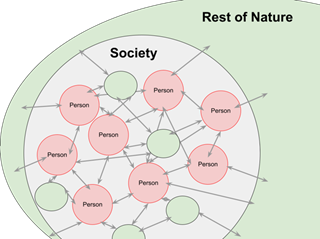
Environmental law is a heterogenous grouping which includes many different issues and approaches. Those outside the discipline should understand that much of environmental law is not ecologically positive, but about facilitating and managing ecologically destructive practices based on human domination of and supremacy over the rest of the natural world, and even protection and conservation elements sometimes contain compromises.
Interconnected Law prompts us to think in terms of socio-ecological relations, coming from the key insight of Social Ecology that any environmental relations are intertwined with social relations. Ecological and environmental thinking is necessarily relational because ecology is relational and thinking about the environment is thinking about human relationships to it. There is environmental law scholarship – such as socio-legal and political ecology approaches – which could be considered to be relational and perhaps sometimes even falling within a socio-ecological paradigm. Yet most legal thinking is still rooted in conceptions of humans as fundamentally separate from nature, and often does not understand humans as socially relational. It is vital to include these understandings in the relational conception, and recognise that all of these relations are interconnected socio-ecological relations.
Interconnected Law thinking regarding environmental law is therefore very useful for analysing environmental issues, critiquing environmental law and regulation, implementation and efficacy of existing regimes, and developing better approaches. Any environmental issue is a complex relational web of various actors and effects, with interwoven social and ecological causes and effects. Law is involved (typically in multiple ways) in producing, structuring, facilitating and managing this relational web. Environmental law thinking should therefore focus on the particular socio-ecological relations around an issue, the underlying social causes, and how legal interventions seek to transform these social relations. Some more complex environmental regulation regimes which take a systemic approach can easily be understood in this way, and may indeed have been consciously designed in a relational manner.
Many activists and conservationists might think that criminalisation or simple permissive regimes may address an issue. Yet beyond the problems of the need for strong institutions and enforcement, for many things prohibition and policing only go a small way in countering the drivers and social causes. For example, if there are competing land uses, where there are local people who need to feed themselves or somehow earn a living, they may not have much choice. Or, at the other end of the scale, large businesses may see dodging fines simply as a cost of doing business, with huge amounts of profit to be made from cash crops to export to wealthy foreigners with ever-increasing demands and standards of living. These problems are more significant in countries with less strong state institutions, but fundamentally the same everywhere. Similarly, legal designations for particular habitats, ecosystems and species might be thought to solve an issue, and campaigners will often push hard to get some aspect of nature designated. However, this must always be seen within the broader social context: the social transformation of the web of relations which cause the particular problems sought to be addressed. It is therefore imperative for environmental campaigners to think carefully about the social (and socio-ecological) relations in play, and build alliances where possible. As is now well-recognised, social justice and ecological problems are very much intertwined, meaning that often working towards ecological justice gives opportunities for (and in some cases necessitates) also working towards social justice.