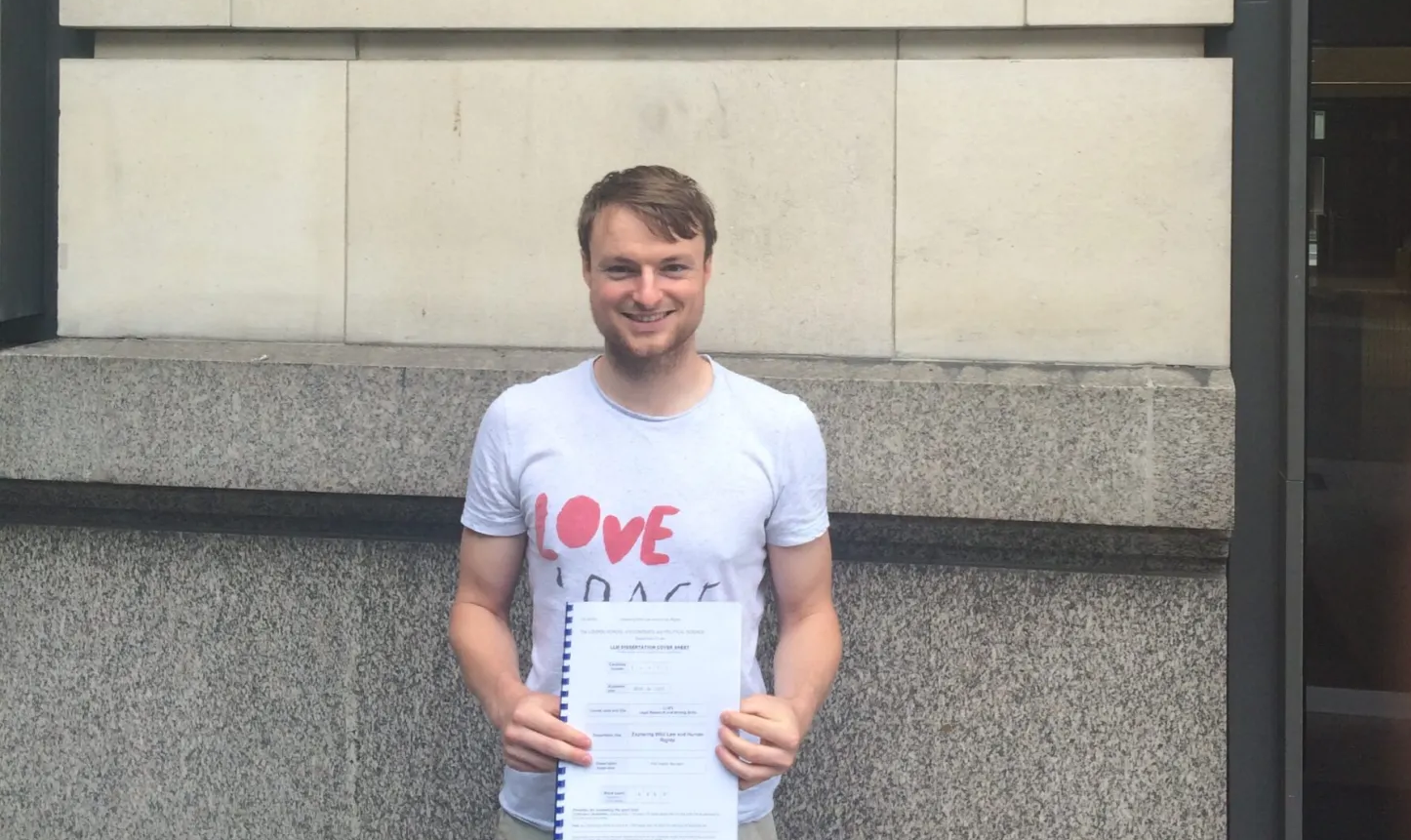
At the start of 2024, the mild and manageable illness I had of post-acute covid syndrome (aka ‘long covid’) suddenly became severe, and I became almost totally incapacitated. Since then, I’ve been slowly working to tie off and publish my two main research projects: my general legal theory work on ‘Interconnected Law’ and my work on Rights of Nature. Though they aren’t as developed as I had been working towards, I am glad that they are now out in the world in some form, and I hope they will be useful. My own dissemination of this work will be very limited, so, if you think it merits it, I ask you to help by sharing it more widely. Further, anyone who wishes to work with the ideas or materials is more than welcome to do so, whether in blog posts, articles, chapters or in presentations (everything on this website is published under a Creative Commons licence).
This blog post has three sections:
My Journey: Studies, Goal, and Illness
Publishing these pieces of work finishes the path I’ve been following since university. As a teenager, I was passionate about social and environmental justice, and took into studying law. I became interested in law’s role in various social issues, but I came to the conclusion that it was about more than just how law was being used: that our understanding of law itself was also part of the problem. In 2017, when I first started brainstorming for my LLM dissertation, it seemed that the different bits of ideas I had and works I had read might tie together into a more general legal theory project… and decided that instead of trying to become a lawyer, legal philosophy was what I should put my effort into. I believed it to be important work, a necessary (and somewhat missing) component in struggles against unjust social orders and working towards a more just society. It was also something I was good at, having been awarded the prize for jurisprudence during my undergraduate degree, and it seemed like few others were working on this particular part of the puzzle.

I came out of my undergraduate studies feeling slightly… lost and disappointed. Most of the studies didn’t seem to tie in well with the issues and injustices I saw in our society and the wider world – it was (of course) about learning how law works, not about political justice, and the culture was mostly about the pipeline into corporate lawyer jobs or clever barrister work. The human rights course was a refreshing break from this, and the academics were involved in real world issues too, though it was primarily about the civil and political rights of liberalism against authoritarianism (per the ECHR). Traditional jurisprudence was interesting but didn’t seem to be really grappling with these issues, so rooted in and held back by flawed liberalism. The environmental law course was refreshing, though only 4 of us had taken it that year! But here and there, during either my undergraduate or master’s studies, I encountered pockets of good critical ideas which I did encounter, either sprinkled on the syllabus here during my master’s. These included critical human rights theory, some bits of critical legal theory, and Rights of Nature, among a few other bits – more on these to come. (My studies were 2011-2015; I suspect things changed a bit with the changed political consciousness that emerged 2015-2020.)
Over the next few years I started to develop these thoughts and wrote a few blog posts – alongside jobs as a research assistant and then a parliamentary assistant to an MP, bits of political activism, and other jobs on the side in gaps – before deciding that attempting a PhD seemed like the best way forward. Around the same time I also started to be more in touch with others working on Rights of Nature in the UK – in the 2010s there weren’t many of us, but towards the end of the decade and into the 2020s more and more people were becoming involved. It all felt quite daunting to me, like I didn’t really know what I was doing, and was I mad to think that I could do some significant philosophical work? But I believed in the project and ideas, and was boosted by a few people saying supportive things over the years.
I started the PhD in 2022, at Birkbeck College in London, and in 2023 things had started to come together well. I was very happy with my supervisors, had a good plan, and was looking towards my ‘upgrade’. After being unable to secure funding, I had been fortunate enough to be hired by Lawyers for Nature as a part-time researcher, which alongside the parkour coaching I was doing gave me just about enough money to get by and do the PhD part-time. The coaching then became incompatible with the illness, but a few months later I was offered a role as associate lecturer at Birkbeck to teach environmental law. It was going to be busy work, but I was amazed and fortunate to be where I had been aiming to be…

… but unfortunately, 4 terms in, I suddenly became very ill. Though initially infected in April 2022, for the first year I could live a normal enough life most days if I avoided exercise. The pathology of PASC and ME/CFS is not yet medically understood, but if there is too much exertion that overwhelms the crippled energy production system of the body, or too much stress, it can cause the illness to worsen. At the end of 2023 I went from a normal-ish but careful life to being severely ill over the course of a couple of weeks. Perhaps I just had a week that was too busy with too many things coming at the same time and overwhelmed my nervous system and things collapsed from there, or perhaps there was some other cause that triggered the severity.
After the first month or two of severe illness, it was clear that recovery would be long and slow. The energy limits are difficult to deal with because of a lag effect: I might do something and feel totally fine, but be totally wiped out the next day. Doing too much causes the illness to get worse. So, recovery is about trying to figure out what small amount is safe to do and holding yourself back at that limit, not pushing at the limits. Recovery is possible, and medical breakthroughs may happen, so I wait and hope, and as long as I avoid big overloads or sudden regressions, I am experiencing gradual improvement. (For anyone interested in my personal blogs on my experience, these are available at www.alexmay.co.uk/blog.)
Research Projects
Following questions I had about law’s role in social justice and how we think about law, I followed a few leads and came across a few things which all seemed to have similar ideas but in different areas. It was these that I recognised could come together into a more general legal theory, a combined social and ecological approach. I believed this to be novel, having only seen small pockets of legal scholarship which suggested such an idea (though perhaps there has been more in the last few years), and quite important, challenging most conventional legal thinking with a big vision about how we should instead be thinking about law.
Jennifer Nedelsky’s relational approach to law was excellent, but it only covered inter-human relations without an ecological dimension. Rights of Nature had ideas of ecological rights and responsibilities, but lacked any social dimension and tended to naively follow liberalism in its political outlook. Capra and Luisi’s Systems View of Life gave a bigger picture about worldviews and paradigms, though the political dimension was disappointing. Slightly later I came across Murray Bookchin’s Social Ecology, which was an excellent conceptual approach for the relationship between humans and the rest of nature, and good political theory too. No legal theory based on social ecology existed, and it seemed to be a good foundation for what I was already trying to weave together. These (along with some other aspects of critical legal theory) were the elements that would become Interconnected Law.

It was quite frustrating that I had a couple of significant research projects which were incomplete and unpublished when I became severely ill – alongside the sadness and grief of the loss due to the illness. So I turned my attention and efforts to tying them off. This work was done on ‘crip time’. My total work capacity – anything using a laptop or phone, which was shared between this work, medical and care admin, writing blog posts and any messaging with friends) – on some days was 5 minutes in total, some days 8 minutes, or 20 minutes, and for some periods no work was possible at all. This work was done in small chunks, then resting a short while before the next little chunk. It is a painfully tedious way to work – I would usually jot down the key words of a sentence or phrase of a section, then foggily put together a sentence or two at a time – but it was the only way, and it felt important to me to tie off the projects I had been devoting my efforts to before getting so ill.
The PhD project had been to develop these ideas for a general approach to legal theory in a socio-ecologically holistic paradigm. I termed it ‘Interconnected Law’ because a project/idea needs a name, and this term covered the key points that humans are interconnected not atomised, and interconnected not separate from nature. The aim was to (i) set out the paradigm of relational socio-ecological world which law operates within; (ii) develop general legal theory for Interconnected Law; then (ii) apply it to or engage with particular legal areas or existing scholarship, such as human rights and Rights of Nature. I could see that this had the potential to be a huge project – more than one person’s life’s work! – as once the foundation was done, it could then engage with any area of law, political issue or existing legal scholarship, as it has relevance for anything involving law. It may have been tricky to fit this into a PhD thesis – which could have been entirely about the paradigm and challenging the (usually subconscious) liberalism which underlies most legal theory, or entirely about the human right to a healthy environment, etc – and may have been more about establishing the paradigm and demonstrating the importance instead of ‘solving’ any one further issue.
So to tie this off, the aim was to put together some sort of overview based on what I already had (available here), and to update my website to be an archive of my work. This was beyond what I was able to do alone, so I engaged a research assistant (Lucy Gavaghan – thanks!) to synthesise from a couple of presentations I had given, past blog posts, my PhD notes, and a one-pager I gave her setting out the structure. I was able to revise parts of it and expand on a few sections on aspects I hadn’t written as much about previously – including writing about human rights and Rights of Nature (a socio-ecological approach to each being novel, as far as I know). But I haven’t let myself revise the whole piece – knowing it has to be left less developed than it might otherwise be and not delayed even longer. Which is of course the whole point of the illness frustrating my ability to do the work, that it is impossible to achieve what I would have wanted to!

My other strand of research work had been on Rights of Nature, trying to develop the legal theory and socio-political dimension. Much like ‘green’ politics traditionally falls short on social justice and political economy, Rights of Nature lacked social dimensions; it followed liberal legal theory with some sort of naive belief that legal rights would solve problems. (That said, since 2020 or so many more people have become interested in Rights of Nature, and there is much more scholarship improving on this.)
As well as a couple of presentations and some blog posts, I published my first research report in 2023, which sought to taxonomise different types of legal intervention, and had begun working on two further reports. The second, on guardianship models, was in partnership with the SOAS student environmental law clinic. I had to drop out, as I also had to stop being involved in a couple of other projects, but they completed it (available here), though I wasn’t able to add my ideas about the political dimensions of different models.
The third report was about legislative frameworks for Rights of Nature. It seeks to map out the breadth and depth of what Rights of Nature legislation could cover, including: different possible elements of a legislative framework; case studies; considering subjecthood as a spectrum; the breadth of legal effects Rights of Nature can have; and some possible legislative models. This came out of discussions about possible UK legislative ideas, and the realisation that no frameworks or comparative analyses had been already completed. I also thought that the general idea of there being two models, personhood or rights, misunderstood things. So, in this report I set out to address both of these shortcomings.

Though I started work on it before becoming ill, the second half of it came after and was done in isolation, looking to tie it off and get it into the world. The collaboration and discussion which was initially started was no longer possible, and being done in isolation changed the nature of the report, as was inevitable. I won’t repeat the methodology section of the report here (!), but some parts didn’t get quite as far as I hoped, while other parts which I might otherwise have kept tighter or saved for elsewhere I wrote more expansively on, driven by the knowledge that this was looking to be my last work on the subject and wanting to say all I had to say. I am proud of the outcome, both given the difficulty in writing it and because I believe it makes good contributions to the literature, in terms of understanding Rights of Nature and encouraging others to take a socio-ecological approach.
I am, of course, very grateful to the support and encouragement received from professors, colleagues, my PhD supervisors, friends, and others along the way. I found it quite daunting to set out on this path, and this helped me to believe in myself and the ideas.
Reflections and Ripples
It’s strange – ‘here’s what I was working on a few years ago’. The illness has meant I’ve been hugely cut off from the world I was previously in. I was/am very glad to be able to do work I was passionate about and felt meaningful as important work towards a more just society; and I am saddened and frustrated that I cannot anymore. It was weighing on me that this work was unfinished and not published. Although it has taken awhile to get this sorted, much slower than this work might have been out in the world, I’m relieved that they now are.
My own dissemination of this research will be very limited, and I hope it finds enough of an audience. There is no PhD, and I am not out in the world telling people about it, giving presentations, submitting to journals, being on podcasts, etc. My belief was that these ideas are important for moving towards a more just society, and my hope is that others can find this useful and take things forward. If you think it merits it, then I ask you to share it more widely. Further, anyone who wishes to work with the ideas or materials is more than welcome to do so (with appropriate acknowledgement or credit), whether in blog posts, articles, chapters or in presentations (everything on this website is published under a Creative Commons licence).
‘Medical retirement’ isn’t some official term, I think it just describes what it is, that I have become unable to work due to illness. There’s still a lot of grief, and I’m still incredibly limited day-to-day. Although a good recovery remains possible such that at some point I am able to do some work, it is definitely not a certainty or expectation, only a hopeful possibility, and I certainly won’t be back on the trajectory I was on before. If anyone is interested in my more personal reflections and experiences of the illness, these can be found at <www.alexmay.co.uk/blog>.
In love, rage, care and solidarity,
Alex
Engaging with those topics is hugely stressful – and for good measure. Here’s a great talk that I think could be useful: amongst some of the other talks like that by Rizwan Virk is another one you might like. Your work on the Rights of Man seems very good, I’d also suggest looking at Systems Theory to get over any “malaise” because challenging the status quo that comes after the enlightenment does result in a huge blowback – I guess I’m saying keep it up and I hope your retirement is more like when Shahid Afridi retired from cricket (aka retired then unretired multiple amount of times).
https://www.patreon.com/thewhyfiles/posts/166694046?utm_campaign=postshare_fan