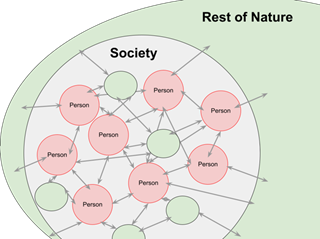
This article was originally written as a section of my piece Interconnected Law: socio-ecological thinking about law (An Overview), but I thought it deserved a stand-alone blog post too. The underlying idea of Interconnected Law and socio-ecological relations is therefore absent here. To give a brief summary: humans, society, and nature are interwoven in dense networks of socio-ecological relations. Individuals do not exist as atomised bounded selves but are inseparable both from social relational webs and the ecological world we live in. Humans are interwoven into a wider ecological world, both as conditions for and influences into human life and our effects ‘out’ into the non-human world. In this sense, our social relations are all also ecological relations, as it is impossible to disentangle them. The other side is also true: that all of our effects on and relationships with non-human nature are also intertwined with our social relations. They must all be understood as socio-ecological relations.
For those who would prefer a downloadable version of this article, here’s a .doc and .pdf:
Socio-ecological Thinking and Environmental Law
Environmental law is a heterogenous grouping which includes many different issues and approaches. Those outside the discipline should understand that much of environmental law is not ecologically positive, but about facilitating and managing ecologically destructive practices based on human domination of and supremacy over the rest of the natural world, and even protection and conservation elements sometimes contain compromises.
Interconnected Law prompts us to think in terms of socio-ecological relations, coming from the key insight of Social Ecology that any environmental relations are intertwined with social relations. Ecological and environmental thinking is necessarily relational because ecology is relational and thinking about the environment is thinking about human relationships to it. There is environmental law scholarship – such as socio-legal and political ecology approaches – which could be considered to be relational and perhaps sometimes even falling within a socio-ecological paradigm. Yet most legal thinking is still rooted in conceptions of humans as fundamentally separate from nature, and often does not understand humans as socially relational. It is vital to include these understandings in the relational conception, and recognise that all of these relations are interconnected socio-ecological relations.
Interconnected Law thinking regarding environmental law is therefore very useful for analysing environmental issues, critiquing environmental law and regulation, implementation and efficacy of existing regimes, and developing better approaches. Any environmental issue is a complex relational web of various actors and effects, with interwoven social and ecological causes and effects. Law is involved (typically in multiple ways) in producing, structuring, facilitating and managing this relational web. Environmental law thinking should therefore focus on the particular socio-ecological relations around an issue, the underlying social causes, and how legal interventions seek to transform these social relations. Some more complex environmental regulation regimes which take a systemic approach can easily be understood in this way, and may indeed have been consciously designed in a relational manner.
Many activists and conservationists might think that criminalisation or simple permissive regimes may address an issue. Yet beyond the problems of the need for strong institutions and enforcement, for many things prohibition and policing only go a small way in countering the drivers and social causes. For example, if there are competing land uses, where there are local people who need to feed themselves or somehow earn a living, they may not have much choice. Or, at the other end of the scale, large businesses may see dodging fines simply as a cost of doing business, with huge amounts of profit to be made from cash crops to export to wealthy foreigners with ever-increasing demands and standards of living. These problems are more significant in countries with less strong state institutions, but fundamentally the same everywhere. Similarly, legal designations for particular habitats, ecosystems and species might be thought to solve an issue, and campaigners will often push hard to get some aspect of nature designated. However, this must always be seen within the broader social context: the social transformation of the web of relations which cause the particular problems sought to be addressed. It is therefore imperative for environmental campaigners to think carefully about the social (and socio-ecological) relations in play, and build alliances where possible. As is now well-recognised, social justice and ecological problems are very much intertwined, meaning that often working towards ecological justice gives opportunities for (and in some cases necessitates) also working towards social justice.
Earth Jurisprudence
Earth Jurisprudence is the most developed ecological approach to law and is thereby the best to weave into a socio-ecologically holistic approach to law. It is a relational approach of sorts, being about relationships between humans and the rest of nature, but it does not include much in the way about social politics or include a relational conception of humans and society. Earth Jurisprudence is a response to current legal systems which conceptualise humans as separate from the rest of nature, and in which (non-human) nature is insufficiently protected and features primarily as property without inherent values or legal subjecthood. Earth Jurisprudence argues that law is not just a neutral tool and goes beyond saying that environmental law has failed to prevent ecological damage and degradation, instead claiming that law facilitates the destruction. Ecological destruction is not just an economic, political or cultural problem with law as a neutral medium. In Cormac Cullinan’s words: “one of the primary causes of environmental destruction is the fact that our governance systems are designed to perpetuate human domination of Nature, instead of fostering mutually beneficial relationships between humans and the other members of the Earth community.” 6
Cullinan proposes that the legal system should work to secure ecological integrity and sustainable relationships between humans and ecological systems by including aspects of (non-human) nature in the legal system as rights subjects with rights and interests. As well as this, the values of the legal systems should include ecological integrity, sustainability, valuing (non-human) nature and rejecting human domination of the rest of nature. The legal system and other governance systems should instead function to work towards harmonious relationships with the rest of nature, instead of domination and extraction. The idea of relational responsibility is also key: an ecological ethic of care that our relationships with non-human nature humans should involve responsibilities, not only rights. The critique of our dominant legal systems having too much of ‘rights without responsibilities’ is present here too, with large corporations highlighted as having rights to property and to act for a profit, but without counterpart responsibilities.
One key element of this is ‘Rights of Nature’ (RoN), which is the idea that non-human elements of nature (such as species, rivers, ecosystems, habitats, communities of animals, etc) have moral rights and should have legal rights and subjecthood. The crucial point of this is that the rights are in the interests of elements of nature – unlike much of environmental law which either serves human interests or is an implementation of some sort of balance struck between human interests and ecological harm. Whereas environmental regulation is piecemeal, Rights of Nature can function to create a baseline of protection against interference. Rights of Nature are being implemented around the world, in constitutions, legislation and case law in countries including Ecuador, Bolivia, New Zealand, India and North America. The UN’s Harmony with Nature programme has also championed the idea, and it continues to gain traction. While this approach may seem radical, it is arguably the best way to realign our legal systems with the sort of far-reaching transformations that are needed for ecological protection and sustainability.
Socio-ecological Development of Rights of Nature
Earth Jurisprudence and Rights of Nature approaches have generally been partial, lacking meaningful consideration of social justice, political dynamics, and just inter-human relations. They are about relationships between humans and the rest of nature, and tend to be framed in terms of moral, cultural, and spiritual transformation. We therefore need a broader approach to encompass the interconnectivity of socio-ecological relations. Interconnected Law is intended to help us move towards societies where humans live in harmony with the rest of nature and have sustainable relations which reflect the particular social context. Ultimately the entire (legal) system must be transformed, and a critique of law’s role in ecological destruction must also critique law’s role in social domination, and address the intertwined social forces driving ecological destruction.
The main ‘orthodox’ Rights of Nature position is rooted in either some form of ‘natural law’ argument or follows liberal thinking and extends liberal approaches to rights to nature-subjects. This is a huge step forward, as Rights of Nature function in the interests of nature-subjects against negative effects from humans (and can include positive dimensions to require action too), and strong Rights of Nature should affect human activities and behaviour. Yet it is crucial to deepen this analysis and explore how these rights function to restructure the socio-ecological relations in human social orders which drive the ecological harms. Campaigners must remember that simply establishing rights in law is not the goal in itself, but only the means with which it is hoped to protect (non-human) nature. Rights of Nature advocates would also do well to bear in mind the mixed legacy of human rights, which often fail to achieve emancipation or social transformation, and learn from critical human rights scholars. The key issue is therefore to consider how legal rights will change the underlying social relations, and legal interventions should have this in mind. The role of state institutions should be carefully considered, and in many cases it will be important to have democratic and decentralised representation for nature-subjects instead of relying only on bureaucratic methods of implementation.
Rights of Nature legal theory remains relatively undeveloped, including as to the nature of the rights. Ideas of rights rooted in liberalism have often been drawn from, yet these are flawed (as discussed above in the section on human rights); aimed primarily at securing individual freedom at the individual scale. For Rights of Nature (as also for human rights), it is vital to think in relational and ecological terms. This is obviously necessary for understanding when the rights may be interfered with and what they demand, because nature-subjects are all about ecological relations and clearly not a ‘bounded self’ as in liberal human rights theory. Yet it is also important for how the rights are conceptualised. Whereas traditional human rights were absolute, more recent jurisprudence (such as Kai Möller’s Global Model of Constitutional Rights) has developed for quantified human rights where interferences can be justified. Competing rights-interests are ‘balanced’ against each other, and the rights are effectively on a spectrum of intensity where the closer to the ‘core’ of a right an interest is, the stronger the weight it has. Implementing Rights of Nature in this way may be the only sensible way to operationalise them, both for themselves and structurally for the inevitable rights-conflicts with human rights and human interests. Of course, the danger (whatever form the rights might take) is that they might have formal legal recognition but not have any substantive effect, with judges giving human interests precedence over those of nature-subjects and the destructive status quo prevailing. This can be addressed by adding normative depth in legislation (or else hope it develops in case law) to give guidance to judges on how to resolve the conflicts of competing interests and ensure an ecological ethic prevails.
This highlights the needs both for a socio-ecological approach by Rights of Nature campaigners and for an ecological ethic to be taken across the whole of a legal (and political) system. Rights of Nature interventions must consider how they will change the underlying social relations which are driving the ecological harms. These are usually complex relational webs in which human interests, ecological harms, harms to human health or other human rights, social injustice and social relations are all intertwined, and Rights of Nature can be on any side of social conflicts. Local communities (or a portion thereof) might be pitted against an external extractive industry, or local communities may be causing ecological harms in land use or extractive practices, and state institutions can be on either (or both) sides of this. The social forces of large corporate entities will need to be tackled too, with Rights of Nature being one possible way to do this. External liability can make a big difference where enforcement and implementation is strong, but ultimately it is internal practice and values which need to be changed.
Working towards ecological justice often gives opportunities for also working towards social justice – and in some cases necessitates this, if unjust social relations are contributing to driving the ecological harm. Rights of Nature campaigners should therefore consider carefully how the rights will interact with these social relations and how they might transform the underlying drivers. There will often be possible alliances between nature-interests and related social justice issues, as well as conflicts with existing human interests to mitigate, and adversarial dynamics to overcome, and working as part of broader social movements will be key. Working with local communities will be crucial, including trying to avoid the ‘conservation’ dynamic where people embedded in a place are removed and instead moving towards harmonious relationships between local communities and their environments.
Ultimately, strong ecological protection (as can be provided by strong Rights of Nature) implementation is beneficial and necessary for humans (though these laws are not for humans). Though in the short term there may be conflicts and difficulties in transformation to sustainable ways of living, humans cannot live without a suitable healthy environment, and environmental problems usually further exacerbate social injustices. A healthy environment must be secured at the ecological scale; it is nonsensical to try and implement it at the individual or human scale. Here, there is a necessary nexus between the human right to a healthy environment and Rights of Nature, which can secure the ecological integrity which humans depend on.
Editorial Notes
- This article was written as part of my medical retirement after becoming severely ill due to post-covid syndrome (aka ‘long covid’). It aims to present some ideas I was working on before becoming ill — the socio-ecological approach to legal thinking being the theme of my PhD thesis, with a chapter of this likely to be about Rights of Nature. Due to necessity, these are condensed thoughts which perhaps fall short of the full academic detail and referencing.
- This article is an excerpt of my full overview piece: https://interconnectedlaw.com/an-overview-of-interconnected-law/.
- For more of my work on Rights of Nature, see https://interconnectedlaw.com/category/rights-of-nature/.